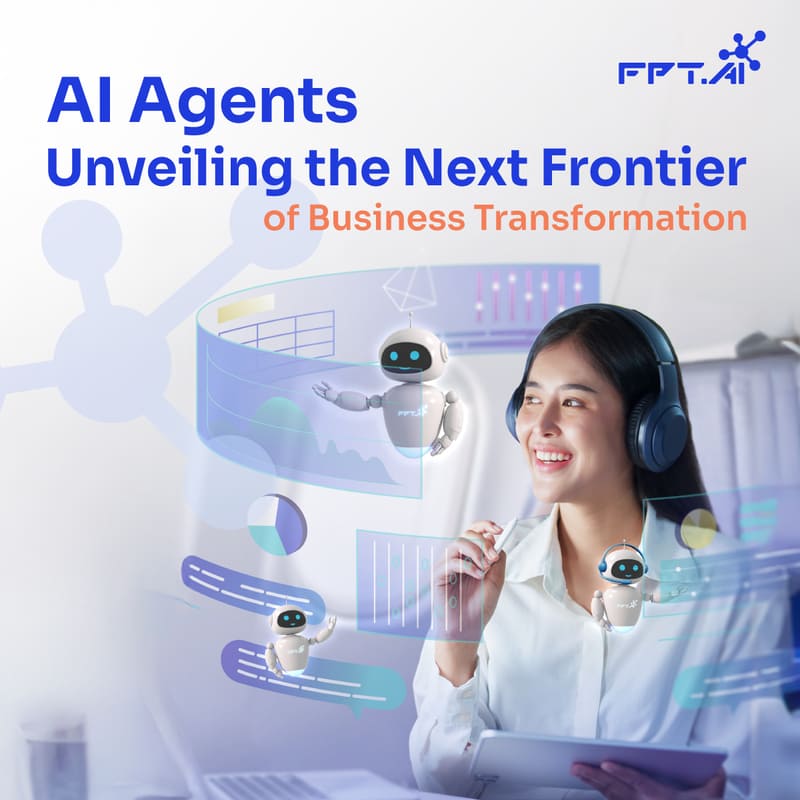
AI Agents are artificial intelligence systems that can interact with the environment and make decisions to achieve goals in the real world without any human guidance or intervention. This technology are shaping technology trends, with notable milestones such as the Google I/O 2023 event launching Astra or the emergence of GPT-4o.
Large corporations are pouring billions of dollars into AI Agents to take the lead in AI Era. In this article, FPT.AI will clarify how AI Agents are helping businesses improve processes, enhance customer experience and optimize operations.
What are AI Agents (Intelligent Agents)?
AI Agents are artificial intelligence systems that can interact with the environment and make decisions in the real world without any human guidance or intervention.
AI Agents can gather information from their surroundings, design their own workflows, use available tools, coordinate between different systems, and even work with other Agents to achieve goals without requiring user supervision or continuous new instructions.
With the development of Generative AI, Natural language processing, Foundation Models, and Large Language Models (LLMs), AI Agents can now simultaneously process multiple types of multimodal information such as text, voice, video, audio, and code. Advanced agent AI can learn and update their behavior over time, continuously experimenting with new solutions to problems until achieving optimal results. Notably, they can detect their own errors and find ways to correct them as they progress.
AI Agents can exist in the physical world (robots, autonomous drones, or self-driving cars) or operate within computers and software to complete digital tasks. The aspects, components, and interfaces of each agent AI can vary depending on its specific purpose. Encouragingly, even people without deep technical backgrounds can now build and use AI Agents through user-friendly platforms.
>>> READ NOW: What is Generative AI? Trends in Applying GenAI from 2024 to 2027
What are the key features of an AI Agent platform?
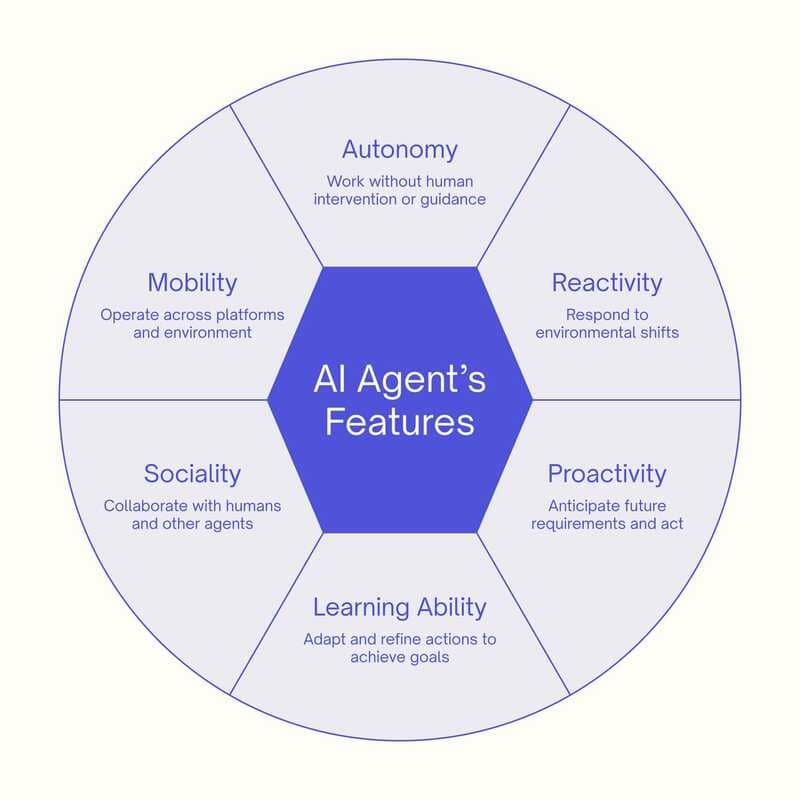
Key features of an AI Agent platform include:
- Autonomy: AI Agents can operate independently, make decisions, and take actions without continuous human supervision. For example, self-driving cars can adjust speed, change lanes, stop, or adjust routes based on real-time sensor data about road conditions and obstacles, without driver intervention.
- Reasoning Ability: AI agents use logic and analyze available information to draw conclusions and solve problems. They can identify patterns in data, evaluate evidence, and make decisions based on the current context, similar to human thinking processes.
- Continuous Learning: AI Agents continuously improve their performance over time by learning from data and adapting to changes in the environment. For instance, customer support chatbots can analyze millions of conversations to gain deeper understanding of common issues and improve the quality of proposed solutions.
- Environmental Observation: AI agents continuously collect and process information from their surroundings through techniques like computer vision, natural language processing, and sensor data analysis. This ability helps them understand the current context and make appropriate decisions.
- Action Capability: AI agents can perform specific actions to achieve goals. These actions can be physical (like a robot moving objects) or digital (like sending emails, updating data, or triggering automated processes).
- Strategic Planning: AI agents can develop detailed plans to achieve goals, including identifying necessary steps, evaluating alternatives, and selecting optimal solutions. This ability requires predicting future outcomes and considering potential obstacles.
- Proactivity and Reactivity: AI agents proactively anticipate and prepare for future changes. For example, Nest Thermostat learns the homeowner’s heating habits and proactively adjusts temperature before the user returns home, while quickly responding to unusual temperature fluctuations.
- Collaboration Ability: AI agents can work effectively with humans and other agents to achieve common goals. This collaboration requires clear communication, coordinated actions, and understanding the roles and objectives of other participants in the system.
- Self-Improvement: Advanced AI agents can self-evaluate and improve their operational performance. They analyze the results of previous actions, adjust strategies based on feedback, and continuously enhance their capabilities through machine learning techniques and optimization.
>>> READ NOW: 2 Ways to Classify Artificial Intelligence and 7 Common Types of AI
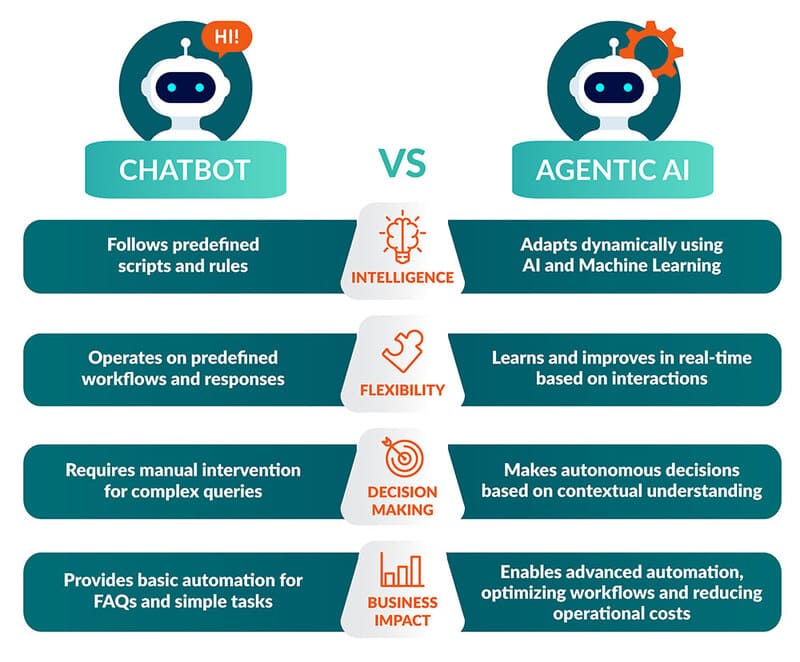
Differences between Agentic AI Chatbots and AI Chatbots
Below is a comparison table highlighting the distinctions between Agentic AI chatbots and AI Chatbots:
| Criteria | Agentic AI Chatbots | Traditional AI Chatbots |
| Autonomy | Operate independently, perform complex tasks without continuous intervention | Require continuous guidance from users, only respond when prompted |
| Memory | Maintain long-term memory between sessions, remember user interactions and preferences | Limited or no memory storage capability, each session typically starts from scratch |
| Tool Integration | Use function calls to connect with APIs, databases, and external applications | Operate in closed environments with no ability to access external tools or data sources |
| Task Processing | Break down complex tasks into subtasks, execute them sequentially to achieve goals | Only process simple, individual requests without ability to decompose complex problems |
| Knowledge Sources | Combine existing knowledge with new information from external sources (RAG) | Rely solely on pre-trained data, unable to update with new information |
| Learning Capability | Continuously learn from interactions, improving accuracy and relevance over time | Do not learn or improve from user interactions, responses always follow fixed patterns |
| Operation Mode | Can perform multiple processing rounds for a single request, creating multi-step workflows | Operate on a single-turn basis (receive-process-respond), without multi-step capabilities |
| Planning Ability | Strategically plan and self-adjust when encountering new information or obstacles | No long-term planning capability or strategy adjustment |
| Personalization | Provide personalized experiences based on user history, preferences, and context | Deliver generalized responses, identical for all users |
| Response Process | Analyze intent, access relevant information, create plan, execute actions, and evaluate results | Recognize patterns, search for appropriate responses in existing database, reply |
| Error Handling | Recognize errors, self-correct, and find alternative solutions when problems arise | Often fail to recognize errors or lack ability to recover when encountering off-script situations |
| User Interaction | Proactively ask clarifying questions, suggest options, and track progress | Passive, only directly respond to what users explicitly ask |
| Workflow | Use threads to store all information, connect with tools, execute function calls when needed | Simple processing according to predefined scripts, no workflow extension capability |
| Practical Applications | Complex customer support, data analysis, process automation, personal assistance | Primarily for FAQs, basic customer support, simple conversations |
| Intent Detection | Accurately identify users’ underlying intents, even when not explicitly stated | Only react to specific keywords or patterns, often missing true intentions |
| System Integration | Easily integrate with multiple systems and applications through APIs | Limited integration capabilities, often requiring custom solutions |
| Development Requirements | Can be developed on no-code platforms, without requiring in-depth programming knowledge | Typically require programming knowledge to build and maintain |
Agentic AI chatbots mark a significant evolution in conversational AI, powered by LLMs but extending well beyond them. Operating on thread-based architecture, they store complete conversation histories, files, and function call results. These advanced chatbots activate via various triggers (scheduled events, database changes, or manual inputs) to analyze requests, interpret intentions, and execute actions autonomously.
Five key innovations drive this technology:
- RAG integration for context-aware responses with higher accuracy
- Function calling to interact with external systems
- Advanced memory systems for continuous learning and adaptation
- Tool evaluation to assess resources and fill information gaps
- Subtask generation to break down complex goals independently
Unlike traditional chatbots’ single-turn model (receive-process-respond), agentic chatbots process multiple turns per prompt, queue actions strategically, and dynamically select appropriate tools based on user intent. They can search connected knowledge bases, call external APIs, or generate responses from core training when external tools aren’t needed. Critically, no-code platforms have democratized their development, accelerating adoption across industries by enabling businesses of all sizes to implement sophisticated AI without significant technical investment.
>>> READ MORE: What is Agentic RAG? Difference between Agentic RAG and RAG
Key Components of AI Agents
AI Agents are composed of multiple components working together as a unified system, similar to how the human body functions with senses, muscles, and brain. Each component in AI Agent Architecture plays a specific role in helping the agent sense, think, and interact with the surrounding world.
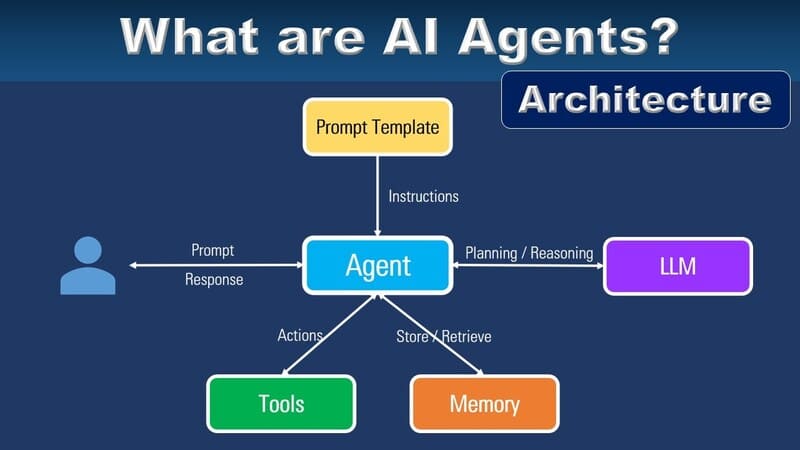
Sensors
Sensors help AI Agents collect information (percepts) from the surrounding environment to understand the context and current situation. In physical robots, sensors might be cameras for “seeing,” microphones for “hearing,” or thermal sensors for “feeling” temperature. For software agents running on computers, sensors might be web search functions to gather online information, or file reading tools to process data from PDF documents, CSV files, or other formats.